Are you worried about cholesterol?
Have you been told your cholesterol is too high and that you’re at risk of heart disease?
Have you cut down on saturated fat — or even cut it out completely as a result?
Every day, I speak to women who are fearful of fat and believe it will make them gain weight or damage their heart or arteries.
It’s time to move beyond this fear and understand that both dietary fat and cholesterol are vital for life.
Cholesterol plays a fundamental role in how the body works. It’s found in every single cell and is especially important for the brain, nervous system, and skin.
Cholesterol has three key roles:
• It forms part of the outer membrane of all our cells, helping determine how well they function
• It’s needed to make vitamin D and steroid hormones (including oestrogen, progesterone, and testosterone), which support bone, muscle, and overall health
• It’s used to make bile, which allows us to digest and absorb the fats we eat
In fact, cholesterol is so essential that the body produces up to 80% of what we need, adjusting its own production based on how much we consume through food — a strong indication of its biological importance.
The brain, in particular, relies heavily on fat and cholesterol (around 60% of the brain is fat). Avoiding fat may therefore play a role in brain-related menopause symptoms such as brain fog.
What many of my clients discover is that the real driver behind both weight gain and raised cholesterol is not fat, but excess refined carbohydrates, sugars, and ultra-processed foods. These spike blood sugar, increase insulin (the body’s main fat-storage hormone), and disrupt metabolic health.
Reducing sugars and refined starches often helps improve both weight and cholesterol markers.
Of course, not all fats are beneficial. Trans fats found in processed foods should be avoided, as should industrially produced seed oils such as sunflower and rapeseed oil.
At the same time, many women aren’t eating nearly enough healthy fats, particularly omega-3 essential fatty acids found in oily fish.
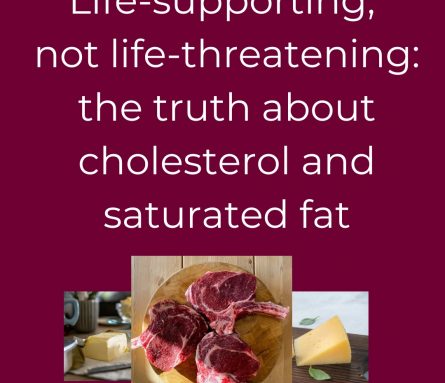
The idea that cholesterol itself causes heart disease is a long-standing myth. Research over decades has shown the picture is far more complex.
Saturated fat from nutrient-dense whole foods behaves very differently in the body compared to saturated fat within ultra-processed products.
This doesn’t mean more is always better — but it does highlight that labelling saturated fat as inherently harmful oversimplifies human biology.
What truly supports heart health is stable blood sugar, low chronic inflammation, nutrient-dense foods, and cooking methods that respect the chemistry of fats, not forgetting the essential omega-3 fatty acids.
The picture that emerges is not one of saturated fat as a threat, but as a misunderstood component of the diet.
Surprised? I’d love to hear your thoughts.