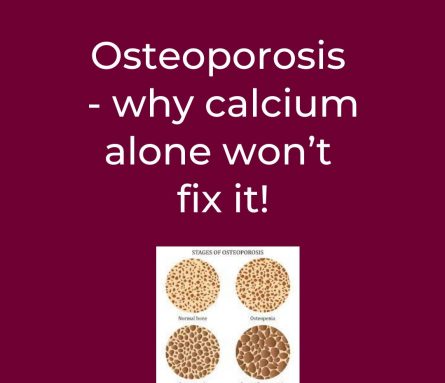
When I was diagnosed with osteoporosis in 2021, I was genuinely shocked.
I thought I was doing everything right—eating well, exercising regularly, ticking all the “healthy lifestyle” boxes. It didn’t seem to add up.
The advice I was given was simple:
“Take calcium and vitamin D.”
And if I’m honest, that’s still the standard advice being handed out in 2026.
But here’s the problem — it’s far too simplistic. And for many people, it’s not addressing the full picture of what’s really going on with bone health.
So, as it’s National Osteoporosis Awareness Month, I want to unpack this a little and share what I’ve learned—both personally and professionally.
It’s not just about calcium
Calcium is important. Of course it is. But more isn’t always better.
For most people with osteoporosis or osteopenia, the target is around 1200mg per day — ideally coming from food first. That’s because nutrients in whole foods are generally better absorbed and utilised by the body.
Here’s something many people don’t realise:
Your blood calcium level is tightly regulated and not a reliable indicator of your overall calcium status.
So being told your calcium is “normal” doesn’t necessarily mean your bones are getting what they need.
Before reaching for a supplement, it’s always worth assessing your current intake. Many people maybe already meeting their needs — or, conversely, relying too heavily on supplements without understanding the bigger picture.
Vitamin D: essential, but not in isolation
Vitamin D plays a crucial role in helping your body absorb calcium. Without it, calcium can’t be effectively utilised.
Optimal vitamin D levels generally sit around 75–100 nmol/L, and in the UK, we simply can’t make enough from sunlight during the winter months.
But again — more isn’t always better. Supplementation should ideally be based on testing, not guesswork.
And importantly, vitamin D doesn’t work alone.
The missing pieces most people aren’t told about
This is where the conversation often falls short.
Because bones don’t just need calcium — they need a team of nutrients and systems working together.
Magnesium and vitamin K2
These are key players. They help ensure that calcium is directed into your bones, where it belongs — rather than being deposited in soft tissues or arteries, where it can be harmful.
Protein
This is a big one, and often overlooked.
Bone isn’t just mineral — it has a protein matrix that gives it structure and strength. Without enough protein, bone health suffers.
As a general guide, aim for at least 1–1.2g of protein per kg of body weight per day, spread across meals.
Other supportive nutrients
Nutrients like vitamin C, zinc, boron, and silicon all contribute to bone formation, collagen production, and mineralisation.
It’s not about mega - dosing these — it’s about ensuring a nutrient-dense, varied diet that provides them consistently.
Gut health and the immune system matter too
This is something that’s only more recently being understood. Your gut plays a role in:
Nutrient absorption
Inflammation regulation
Immune signalling
All of which can influence bone health.
A diet rich in diverse plant foods — vegetables, herbs, and low-sugar fruits—helps support a healthy gut microbiome, which in turn supports your bones.
Bones need stimulus to stay strong
Perhaps the most overlooked piece of all…
Bones are living, dynamic tissue.
Around 10% of your skeleton is renewed every year, but this process depends on the signals your body receives.
If you’re not giving your bones a reason to stay strong, they won’t.
What does that mean in practice?
Strength training
Weight-bearing exercise
Impact work (where appropriate), like brisk walking, jogging, or even hopping
These activities stimulate bone-building cells and help maintain (or improve) bone density over time.
The bigger picture
Osteoporosis isn’t simply a calcium deficiency.
It’s the result of multiple factors coming together:
Nutrient status
Hormonal changes
Physical activity levels
Gut and immune health
Ageing and lifestyle patterns
Which means the solution needs to be just as multi-faceted.
So where does that leave you?
If you’ve been told to “just take calcium and vitamin D,” it might be time to look a little deeper.
Ask yourself:
Am I getting enough protein?
Am I supporting the co-factors that help calcium work properly?
Am I doing the right kind of exercise for my bones?
Is my diet diverse and nutrient-dense?
Because when you start to address bone health from a whole-body perspective, that’s when you begin to see meaningful, lasting change.
If you’re worried about osteoporosis, osteopenia, or fracture risk — and want a more personalised, evidence-based approach, I’d be very happy to support you.
Feel free to get in touch or ask any questions.