
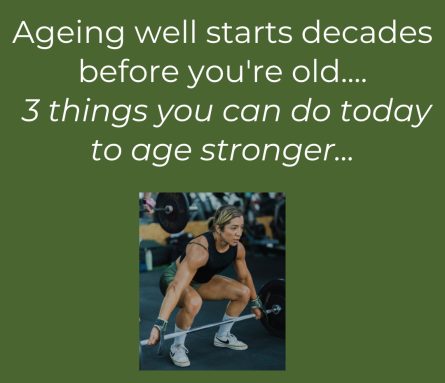
Ageing well starts decades before you’re old: 3 things you can do today to age stronger…

Don’t wait until you’re old to start ageing well.

We often talk about healthy ageing as though it means looking after different parts of the body separately.

Protect your bones.

Maintain your muscle.

Look after your brain.

But your body doesn't work in compartments. Your bones, muscles and brain are interconnected - and the lifestyle choices you make today can influence how well all three function as you get older. This matters because healthy ageing isn't simply about living longer.

It's about maintaining your strength, mobility, independence, cognitive function and quality of life for as long as possible.

And you don't need to wait for your 60s, 70s or 80s to start. In fact, the earlier you start, the better.

1. Lift something heavy

If there's one message I would love more women to understand about healthy ageing, it's this: Strength training isn't just for bodybuilders or people who want bigger muscles. It's one of the most important investments you can make in your future health.

As we age, maintaining muscle becomes increasingly important. Muscle supports movement, balance and physical function - and having greater strength gives you more physical reserve when life throws challenges at you.

But your muscles aren't the only tissues responding to resistance exercise. Your bones respond to loading too. Bones are living tissue. They continually remodel in response to the demands placed upon them.

This is one reason resistance and weight-bearing exercise are such an important part of a bone-health strategy.

And there's another piece of the puzzle that is easy to overlook. Your brain is involved every time you move. Strength training requires your brain to coordinate movement, balance, body position, force and motor control. You're not simply contracting a muscle. You're asking your nervous system to organise and adapt to a physical challenge. So when you strength train, you're not simply “working your muscles”. You're giving your musculoskeletal and nervous systems a reason to stay capable.

That doesn't mean you need to lift enormous weights. It means giving your body an appropriate challenge and gradually progressing it over time. We’re talking:

• Squats
• Deadlifts
• Lunges
• Carrying something heavy (including shopping bags)
• Getting up and down from the floor.

The exact exercises matter less than consistently giving your body a reason to remain strong and functional.

Don't just exercise to burn calories. Exercise to build capacity and strength. Because the goal of healthy ageing isn't simply to weigh less. It's to be able to carry your shopping, climb stairs, get up from a chair, lift a suitcase, play with your grandchildren, walk confidently and remain independent. That's a very different goal.

2. Eat enough protein - and spread it across the day

Here's another uncomfortable truth: Muscle doesn't maintain itself. Your body needs the raw materials to repair and maintain muscle tissue.

Protein provides amino a amino acids, which are essential for building and maintaining body tissues. Yet many people eat very little protein at breakfast, perhaps a modest amount at lunch, and then consume most of their protein at dinner.

For healthy ageing, it's worth thinking beyond simply asking: “How much protein do I eat?” Also ask: “How well am I distributing it across the day?”

A breakfast of toast and jam followed by a light lunch may leave very little protein available to support muscle protein synthesis until dinner.
Instead, think about building protein into every meal. We’re talking:

• Eggs
• Greek yoghurt
• Fish
• Chicken
• Meat
• Tofu and tempeh
• Beans and lentils
• Cottage cheese
• Nuts and seeds can contribute too, although they are generally less protein-dense than many animal or soy-based sources.

The exact amount you need depends on your age, body size, activity level, health and circumstances.

But one principle is increasingly important as we get older: Don't wait until you have lost muscle to start thinking about protein.
Build the habit now. And combine adequate protein with resistance training. Nutrition provides the building blocks. Training provides the reason to use them.

3. Feed your whole body - not just your brain

We love the idea of a “brain food”.

• Blueberries.
• Walnuts.
• Oily fish.
• Dark chocolate.
• Coffee.

And while individual foods can certainly be nutritious, there's a bigger picture that is often missed.

Your brain is part of your body. It doesn't exist in isolation. Your brain is supplied by your blood vessels. It depends on energy metabolism. It requires oxygen and nutrients. It is influenced by inflammation, sleep, physical activity, metabolic health and the health of the rest of your body.

So instead of searching for a single miracle food for brain health, think about your overall dietary pattern. A diet rich in:

• vegetables and fruit
• legumes
• wholegrains
• nuts and seeds
• oily fish and other sources of omega-3 fats
• extra virgin olive oil and other unsaturated fats
• adequate protein
• herbs and spices
• plenty of fibre and plant diversity

can provide a broad spectrum of nutrients and other bioactive compounds.

And don't forget the gut. Your gut and brain communicate constantly through what is often described as the gut–brain axis. Your gut microbiome interacts with your immune system, metabolism and nervous system.

One of the simplest ways to support a diverse microbiome is also one of the least glamorous: Eat more plants - and eat a wide variety of them.

Different plant foods provide different types of fibre and plant compounds for your gut microbes to work with. So perhaps instead of asking: “What's the best food for my brain?” ask: “How much variety is there on my plate?”

The real goal isn't simply longevity such as how can we live to 90 or 100 - isn’t it more about how you want to live those years? Because there is a huge difference between simply adding years to life and maintaining the capacity to enjoy those years.

Can you walk comfortably?
Can you carry your own shopping?
Can you get up from the floor?
Can you climb stairs?
Can you travel?
Can you enjoy time with friends and family?
Can you continue doing the things that make life worth living?
Can you maintain your cognitive abilities and independence for as long as possible?

That's what I mean when I’m talking about healthy ageing. Your future self is being built now. You don't suddenly become “old” on your 70th birthday.

Healthy ageing is a process. And every day gives you another opportunity to influence your future self.

You don't need a perfect diet.
You don't need an expensive supplement regime.
You don't need to spend two hours in the gym.
You don't need to chase every new longevity trend.

Start with the fundamentals.

Today, you could:

1. Lift something heavy - Challenge your muscles and give your bones a reason to adapt.
2. Put a quality source of protein on your plate at each meal - Give your body the building blocks it needs.
3. Add more variety to your diet - Different plants. Different colours. Different sources of fibre and healthy fats.

Small actions repeated consistently can become powerful habits. Because getting older is inevitable. But how well you age is influenced by what you do along the way.

So ask yourself: What are you doing today that your 80-year-old self will thank you for?

That's where healthy ageing really begins.

RitchNutrition

Helen Ritchie

Windsor, UK & Online

BANT Registered Nutritional Therapist

CNHC Registered Practitioner


E: helen@ritchnutrition.com

M: 07884 117768

© Helen Ritchie | RitchNutrition | All rights reserved | 2021 to 2026 powered by Webhealer

Privacy Policy

Privacy Policy

Privacy Policy

Introduction


RitchNutrition is registered with the Information Commissioner's Office (ICO) as a data controller and collects data for a variety of purposes. A copy of the registration is available through the ICO website (search by business name). My registration reference is: ZB180172

RitchNutrition holds some information about you. This document outlines how that information is used, who I may share that information with and how I keep it secure. This notice does not provide exhaustive detail. However, I am happy to provide any additional information or explanation needed. Any requests for this should be sent to helen@ritchnutrition.com. I keep this Privacy Notice under regular review. This Privacy Notice was last reviewed in June 2026.

What I Do

RitchNutrition provides nutritional therapy services to clients to improve their health through diet and lifestyle interventions. I focus on preventative healthcare, the optimisation of physical and mental health and chronic health conditions. Through nutritional therapy consultations, dietary and lifestyle analysis and biochemical testing, I aim to understand the underlying causes of your health issues which we will seek to address through personalised dietary therapy, nutraceutical prescription (supplements) and lifestyle advice. RitchNutrition also provides corporate well-being talks and workshops.

How I Obtain Your Personal Data


Information provided by you

You provide me with personal data in the following ways:

* By completing a nutritional therapy questionnaire

* By signing a terms of engagement agreement form

* During a nutritional therapy consultation

* Through email, over the telephone or by post

* By taking credit card and online payment


This may include the following information:

* basic details such as name, address, contact details and next of kin

* details of contact I have had with you such as referrals and appointment requests

* health information including your previous medical history, dietary, lifestyle, supplement and medicine details, biochemical test results, clinic notes and health improvement plans

* GP contact information

* Bank details


I use this information in order to provide you with direct healthcare. This means that the legal basis of my holding your personal data is for legitimate interest.


Following completion of your healthcare we retain your personal data for the period defined by our professional association BANT and registrant body, CHNC. This enables us to process any complaint you may make. In this case the legal basis of our holding your personal data is for contract administration.


Information I get from other sources

I may obtain sensitive medical information in the form of test results from biochemical testing companies. I use this information in order to provide you with direct healthcare. This means that the legal basis of my holding your personal data is for legitimate interest.

I may obtain sensitive information from other healthcare providers. The provision of this information is subject to you giving me your express consent. If I do not receive this consent from you, I will not be able to coordinate your healthcare with that provided by other providers which means the healthcare provided by me may be less effective.

How I use your personal data

I act as a data controller for use of your personal data to provide direct healthcare. I also act as a controller and processor in regard to the processing of your data from third parties such as testing companies and other healthcare providers. I act as a data controller and processor in regard to the processing of credit card and online payments.

I undertake at all times to protect your personal data, including any health and contact details, in a manner which is consistent with my duty of professional confidence and the requirements of the General Data Protection Regulation (GDPR) concerning data protection. I will also take reasonable security measures to protect your personal data storage.

I may use your personal data where there is an overriding public interest in using the information e.g. in order to safeguard an individual, or to prevent a serious crime. Also where there is a legal requirement such as a formal court order. I may use your data for marketing purposes such as newsletters but this would be subject to you giving me your express consent.

Do you share my information with other organisations?

I will keep information about you confidential. I will only disclose your information with other third parties with your express consent with the exception of the following categories of third parties:

* My registrant body, CNHC and my professional association, BANT, for the processing of a complaint made by you

* Any contractors and advisors that provide a service to me or act as my agents on the understanding that they keep the information confidential

* Anyone to whom I may transfer my rights and duties under any agreement I have with you

* Any legal or crime prevention agencies and/or to satisfy any regulatory request (eg, CNHC) if we have a duty to do so or if the law allows us to do so

I may share your information with supplement companies and biochemical testing companies as part of providing you with direct healthcare. I will not include any sensitive information

I will seek your express consent before sharing your information with your GP or other healthcare providers. However if I believe that your life is in danger then I may pass your information onto an appropriate authority (such as the police, social services in the case of a child or vulnerable adult, or GP in case of self-harm) using the legal basis of vital interests.

I may share your case history in an anonymised form with my peers for the purpose of professional development. This may be at clinical supervision meetings, conferences, online forums, and through publishing in medical journals, trade magazines or online professional sites. I will seek your explicit consent before processing your data in this way.

What are your rights?

Every individual has the right to see, amend, delete or have a copy, of data held that can identify you, with some exceptions. You do not need to give a reason to see your data.

If you want to access your data you must make a subject access request in writing to helen@ritchnutrition.com. Under special circumstances, some information may be withheld. I shall respond within 20 working days from the point of receiving the request and all necessary information from you. My response will include the details of the personal data I hold on you including:

* Sources from which I acquired the information

* The purposes of processing the information

* Persons or entities with whom I am sharing the information You have the right, subject to exemptions, to ask to:

* Have your information deleted

* Have your information corrected or updated where it is no longer accurate

* Ask me to stop processing information about you where I am not required to do so by law or in accordance with the BANT and CNHC guidelines.

* Receive a copy of your personal data, which you have provided to me, in a structured, commonly used and machine readable format and have the right to transmit that data to another controller, without hindrance from me.

* Object at any time to the processing of personal data concerning you

I do not carry out any automated processing, which may lead to automated decisions based on your personal data.

If you would like to invoke any of the above rights then please write to the Data Controller at 57 Albert Street, Windsor, SL4 5BT or email helen@ritchnutrition.com<mailto:helen@ritchnutrition.com>.

What safeguards are in place to ensure data that identifies me is secure?


I only use information that may identify you in accordance with GDPR. This requires me to process personal data only if there is a legitimate basis for doing so and that any processing must be fair and lawful.


Within the health sector, I also have to follow the common law duty of confidence, which means that where identifiable information about you has been given in confidence, it should be treated as confidential and only shared for the purpose of providing direct healthcare. I will protect your information, inform you of how your information will be used, and allow you to decide if and how your information can be shared.


I also ensure the information I hold is kept in secure locations, restrict access to information to authorised personnel only, protect personal and confidential information held on equipment such as laptops with encryption (which masks data so that unauthorised users cannot see or make sense of it). I ensure external data processors that support me are legally and contractually bound to operate and prove security arrangements are in place where data that could or does identify a person are processed.


RitchNutrition is registered with the Information Commissioner's Office (ICO) as a data controller and collects data for a variety of purposes. A copy of the registration is available through the ICO website (search by business name).

How long do you hold confidential information for?

All records held by RitchNutrition will be kept for the duration specified by guidance from our professional association BANT.

Analytics


Like most websites, I make use of analytics software in order to help me understand the trends in popularity of my website and of different sections. I make no use of personally identifiable information in any of the statistical reports I use from this package. I use an analytics package called Google Analytics who provide details of their privacy policy on the Google website.

Complaints

If you would like to invoke any of the above rights then please write to the Data Controller at 57 Albert Street, Windsor, SL4 5BT or email helen@ritchnutrition.com

If your complaint is not resolved to your satisfaction and you wish to make a formal complaint to the Information Commissioner's Office (ICO), you can contact them on 01625 545745 or 0303 1231113.

Privacy Policy

Cookies

Cookies are small text files that are placed on your computer by websites that you visit. They are widely used in order to make websites work, or work more efficiently, as well as to provide information to the owners of the site.

This website does not require cookies in order to function properly. The information below explains the cookies we use and why.

Cookie
Used For
Cookie Bar (cb-enabled)

This is used to remember whether you have clicked the button to acknowledge our use of cookies. Without this, the bar would always show.

Social Media Sharing Facebook, Twitter, YouTube, Google, AddThis

We include Facebook and Twitter plugins on this website to help you share content that may be of interest to your social network. We also use AddThis, which is a service allowing social media sharing with a range of alternatives to Facebook and Twitter. Some pages may also include Google or YouTube features which need cookies in order to work, improve service and prevent fraud.


Note that Social Media companies usually design cookies in a way that enable them to track your activity across multiple websites and this may be a reason you choose to disable cookies.

Taking Control of Your Cookies

You have the ability to accept or decline cookies by modifying the settings in your browser, however you may not be able to use all the interactive features of our site if cookies are disabled. To find out more about cookies, including how to see what cookies have been set and how to manage and delete them, visit www.aboutcookies.org.