Don’t wait until you’re old to start ageing well.
We often talk about healthy ageing as though it means looking after different parts of the body separately.
Protect your bones.
Maintain your muscle.
Look after your brain.
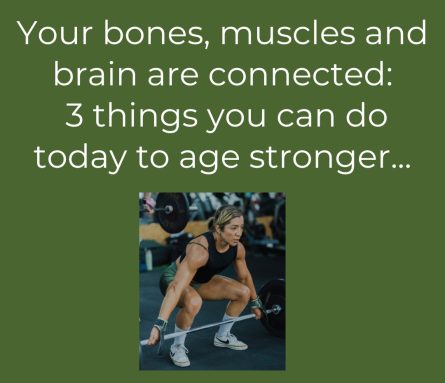
But your body doesn't work in compartments. Your bones, muscles and brain are interconnected - and the lifestyle choices you make today can influence how well all three function as you get older. This matters because healthy ageing isn't simply about living longer.
It's about maintaining your strength, mobility, independence, cognitive function and quality of life for as long as possible.
And you don't need to wait for your 60s, 70s or 80s to start. In fact, the earlier you start, the better.
1. Lift something heavy
If there's one message I would love more women to understand about healthy ageing, it's this: Strength training isn't just for bodybuilders or people who want bigger muscles. It's one of the most important investments you can make in your future health.
As we age, maintaining muscle becomes increasingly important. Muscle supports movement, balance and physical function - and having greater strength gives you more physical reserve when life throws challenges at you.
But your muscles aren't the only tissues responding to resistance exercise. Your bones respond to loading too. Bones are living tissue. They continually remodel in response to the demands placed upon them.
This is one reason resistance and weight-bearing exercise are such an important part of a bone-health strategy.
And there's another piece of the puzzle that is easy to overlook. Your brain is involved every time you move. Strength training requires your brain to coordinate movement, balance, body position, force and motor control. You're not simply contracting a muscle. You're asking your nervous system to organise and adapt to a physical challenge. So when you strength train, you're not simply “working your muscles”. You're giving your musculoskeletal and nervous systems a reason to stay capable.
That doesn't mean you need to lift enormous weights. It means giving your body an appropriate challenge and gradually progressing it over time. We’re talking:
• Squats
• Deadlifts
• Lunges
• Carrying something heavy (including shopping bags)
• Getting up and down from the floor.
The exact exercises matter less than consistently giving your body a reason to remain strong and functional.
Don't just exercise to burn calories. Exercise to build capacity and strength. Because the goal of healthy ageing isn't simply to weigh less. It's to be able to carry your shopping, climb stairs, get up from a chair, lift a suitcase, play with your grandchildren, walk confidently and remain independent. That's a very different goal.
2. Eat enough protein - and spread it across the day
Here's another uncomfortable truth: Muscle doesn't maintain itself. Your body needs the raw materials to repair and maintain muscle tissue.
Protein provides amino a amino acids, which are essential for building and maintaining body tissues. Yet many people eat very little protein at breakfast, perhaps a modest amount at lunch, and then consume most of their protein at dinner.
For healthy ageing, it's worth thinking beyond simply asking: “How much protein do I eat?” Also ask: “How well am I distributing it across the day?”
A breakfast of toast and jam followed by a light lunch may leave very little protein available to support muscle protein synthesis until dinner.
Instead, think about building protein into every meal. We’re talking:
• Eggs
• Greek yoghurt
• Fish
• Chicken
• Meat
• Tofu and tempeh
• Beans and lentils
• Cottage cheese
• Nuts and seeds can contribute too, although they are generally less protein-dense than many animal or soy-based sources.
The exact amount you need depends on your age, body size, activity level, health and circumstances.
But one principle is increasingly important as we get older: Don't wait until you have lost muscle to start thinking about protein.
Build the habit now. And combine adequate protein with resistance training. Nutrition provides the building blocks. Training provides the reason to use them.
3. Feed your whole body - not just your brain
We love the idea of a “brain food”.
• Blueberries.
• Walnuts.
• Oily fish.
• Dark chocolate.
• Coffee.
And while individual foods can certainly be nutritious, there's a bigger picture that is often missed.
Your brain is part of your body. It doesn't exist in isolation. Your brain is supplied by your blood vessels. It depends on energy metabolism. It requires oxygen and nutrients. It is influenced by inflammation, sleep, physical activity, metabolic health and the health of the rest of your body.
So instead of searching for a single miracle food for brain health, think about your overall dietary pattern. A diet rich in:
• vegetables and fruit
• legumes
• wholegrains
• nuts and seeds
• oily fish and other sources of omega-3 fats
• extra virgin olive oil and other unsaturated fats
• adequate protein
• herbs and spices
• plenty of fibre and plant diversity
can provide a broad spectrum of nutrients and other bioactive compounds.
And don't forget the gut. Your gut and brain communicate constantly through what is often described as the gut–brain axis. Your gut microbiome interacts with your immune system, metabolism and nervous system.
One of the simplest ways to support a diverse microbiome is also one of the least glamorous: Eat more plants - and eat a wide variety of them.
Different plant foods provide different types of fibre and plant compounds for your gut microbes to work with. So perhaps instead of asking: “What's the best food for my brain?” ask: “How much variety is there on my plate?”
The real goal isn't simply longevity such as how can we live to 90 or 100 - isn’t it more about how you want to live those years? Because there is a huge difference between simply adding years to life and maintaining the capacity to enjoy those years.
Can you walk comfortably?
Can you carry your own shopping?
Can you get up from the floor?
Can you climb stairs?
Can you travel?
Can you enjoy time with friends and family?
Can you continue doing the things that make life worth living?
Can you maintain your cognitive abilities and independence for as long as possible?
That's what I mean when I’m talking about healthy ageing. Your future self is being built now. You don't suddenly become “old” on your 70th birthday.
Healthy ageing is a process. And every day gives you another opportunity to influence your future self.
You don't need a perfect diet.
You don't need an expensive supplement regime.
You don't need to spend two hours in the gym.
You don't need to chase every new longevity trend.
Start with the fundamentals.
Today, you could:
1. Lift something heavy - Challenge your muscles and give your bones a reason to adapt.
2. Put a quality source of protein on your plate at each meal - Give your body the building blocks it needs.
3. Add more variety to your diet - Different plants. Different colours. Different sources of fibre and healthy fats.
Small actions repeated consistently can become powerful habits. Because getting older is inevitable. But how well you age is influenced by what you do along the way.
So ask yourself: What are you doing today that your 80-year-old self will thank you for?
That's where healthy ageing really begins.