
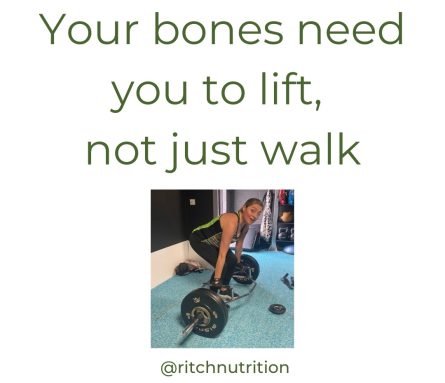
Walking is great. But your bones need more than steps.
Bone is living tissue, and it responds to load. Challenge it and it gets the signal to stay strong. Give it little to respond to, and it has less reason to. So what happens when women with low bone mass lift properly heavy?
What the LIFTMOR trial found
The LIFTMOR trial, published in the Journal of Bone and Mineral Research in 2018, randomised 101 postmenopausal women with low bone mass to one of two groups. One group did 8 months of supervised, heavy resistance and impact training, twice a week for 30 minutes. The other did a gentle home exercise programme.
The results:
• Spine: lumbar spine bone density rose by 2.9% in the heavy-training group, while the gentle group lost 1.2%.
• Hip: bone density at the femoral neck held steady in the training group (up 0.3%), compared with a 1.9% fall in the gentle group.
• Function: the women in the training group also improved their strength and physical function, and kept their height.
On safety, the training was closely supervised, and the only adverse event reported was one minor back spasm. A follow-up analysis found no vertebral fractures.
The caveats matter
This is an encouraging study, but it isn't necessarily a license to start heavy lifting on your own.
• It was a single trial, and the sessions were supervised by trained staff.
• The women were screened and otherwise healthy.
• It measured bone density, not fractures, so it can't tell us the training reduced fracture risk.
If you're new to strength training do work with a qualified coach to supervise form, to avoid injury.
And don't underestimate walking!
Brisk walking is also beneficial for bone health. Research has linked a faster walking pace with better hip bone density, and newer evidence supports brisk walking or jogging as a useful bone-loading activity. The gains are modest and the evidence is not as strong as for heavier training, but walking is accessible, free and easy to keep up.
As a practical target:
• Aim for 20 to 40 minutes of purposeful, brisk walking.
• Around 100 to 120 steps per minute is a useful guide to walking intensity, depending on your fitness and stride.
• Include hills or inclines where appropriate.
But here's the distinction: walking and strength training provide different mechanical stimuli. Both have a place in a bone-health programme.
For women with osteoporosis, exercise should always be adapted to their individual fracture risk and physical capabilities. Take particular care to reduce your risk of falls, and choose safe, even routes while you build up.
My own story
In 2021, a scan told me I had osteoporosis. It came as a complete surprise. Over the last five years, my bone density has improved, which iss why I care so much about this topic.
What to do next
1. Add strength training: aim for at least two sessions a week, begin light, learn the technique, then progress gradually.
2. Keep walking briskly: it's a useful partner to strength work, not a replacement for it.
3. Eat enough protein: spread it through the day, because bone has a protein framework and muscle loads your skeleton.
4. Get the bone-supporting nutrients: calcium, vitamin D, vitamin K2 and magnesium, from food first.
Where to start
If you'd like to know whether your nutrition is supporting your bones, my Nutrition Audit (£95) looks at your diet, lifestyle and risk factors and gives you a personalised plan.
Sources: Watson SL et al., High-Intensity Resistance and Impact Training Improves Bone Mineral Density and Physical Function in Postmenopausal Women With Osteopenia and Osteoporosis: The LIFTMOR Randomized Controlled Trial. Journal of Bone and Mineral Research, 2018. Coupland CA et al., Habitual physical activity and bone mineral density in postmenopausal women in England. International Journal of Epidemiology, 1999.